 Skip to content
Creating Custom Digital Commerce Assistants Without Breaking the Bank
In today’s competitive digital commerce landscape, chatbots have evolved from novelty to necessity. They provide 24/7 customer support, qualify leads, and facilitate transactions—all without human intervention. While enterprise-grade solutions come with hefty price tags, the democratization of AI technology has made it possible for even small digital commerce businesses to build sophisticated chatbots on minimal budgets. This comprehensive guide walks you through creating your own AI-powered digital commerce assistant in 2025.
Why Digital Commerce Businesses Need Custom Chatbots
Off-the-shelf chatbot solutions often lack the specialized knowledge about your unique products, services, and policies that digital commerce customers need. Building a custom solution allows you to:
- Provide product recommendations based on your specific inventory
- Answer detailed questions about your shipping policies and return procedures
- Process orders and track shipments within your fulfillment system
- Reflect your brand’s unique voice and personality
- Integrate seamlessly with your existing digital commerce platform
Essential Components for a DIY Digital Commerce Chatbot
1. Conversational Framework
Several open-source frameworks provide the foundation for building digital commerce chatbots:
Rasa Open Source: This free framework includes natural language understanding and dialogue management capabilities specifically adaptable to digital commerce applications. Its active community offers numerous pre-built components for common e-commerce functions.
BotPress Community Edition: With a user-friendly visual interface, BotPress allows non-technical users to create sophisticated digital commerce chatbots through a flowchart-like design process.
2. Natural Language Understanding (NLU)
For your chatbot to comprehend customer queries effectively, you’ll need NLU capabilities:
HuggingFace Transformers: This free library provides access to powerful language models that can be fine-tuned for digital commerce applications with relatively minimal computing resources.
NLTK (Natural Language Toolkit): This open-source library offers text classification, tokenization, and entity recognition functions essential for understanding customer inquiries in a digital commerce context.
3. Knowledge Base
Your chatbot needs information to share with customers:
Pinecone Community Edition: This vector database allows your chatbot to quickly retrieve relevant product information and digital commerce policies based on semantic similarity to customer queries.
GitHub Wiki: A simple but effective way to store and maintain your chatbot’s knowledge base about your digital commerce operations.
Step-by-Step Guide to Building Your Digital Commerce Chatbot
1. Define Your Chatbot’s Scope
Start by clearly defining what your digital commerce chatbot should and shouldn’t do:
Core Functionalities:
- Answer product availability questions
- Provide order status updates
- Explain shipping and return policies
- Recommend products based on customer preferences
- Facilitate simple transactions
Advanced Features to Consider:
- Integration with inventory management
- Personalization based on customer history
- Multilingual support for international customers
- Hand-off protocols for complex inquiries
2. Collect and Organize Training Data
Your digital commerce chatbot will need examples of customer inquiries and appropriate responses:
- Export customer service chat logs (anonymized)
- Compile FAQs from your help center
- Document common product questions
- Create sample dialogues for ordering processes
Organize these into intents (what the customer wants) and entities (specific objects they’re asking about) relevant to digital commerce interactions.
3. Select and Set Up Your Framework
For this tutorial, we’ll use Rasa Open Source due to its flexibility for digital commerce applications:

4. Configure NLU Training
Modify the nlu.yml file to include digital commerce-specific intents:

5. Define Conversation Flows
Create stories that represent typical digital commerce interactions:

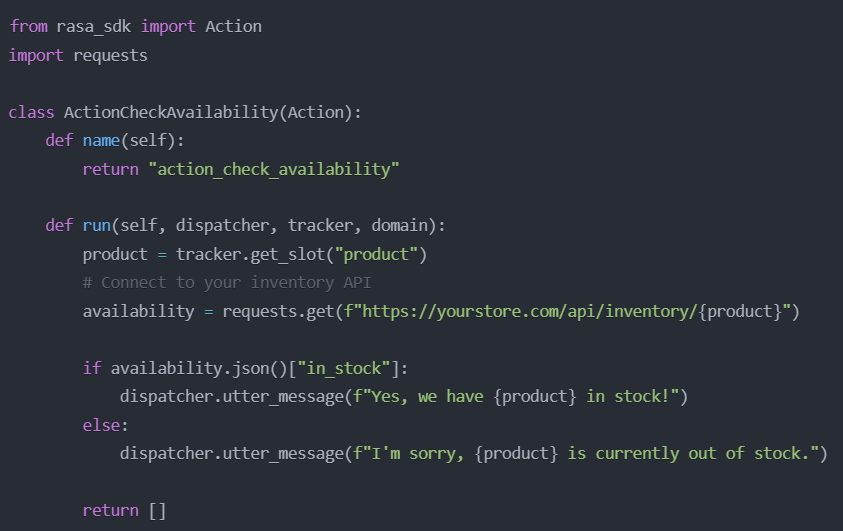
6. Connect to Your Digital Commerce Platform
Write custom actions to connect your chatbot to your e-commerce system:
7. Test and Iterate
Before launching, thoroughly test your chatbot with scenarios specific to your digital commerce operations:
- Product inquiries for items that are in and out of stock
- Order tracking with valid and invalid order numbers
- Complex questions that should trigger human handoff
8. Deployment Options
Several affordable hosting options exist for your digital commerce chatbot:
Heroku Free Tier: Suitable for low-volume digital commerce sites with occasional chatbot usage.
Google Cloud Platform Free Tier: Offers enough resources for small to medium digital commerce operations.
Your Existing Hosting: If you already have hosting for your digital commerce site, you can likely deploy your chatbot there with minimal additional cost.
Enhancing Your DIY Digital Commerce Chatbot
Integration with Analytics
Connect your chatbot to free analytics tools to track performance:
Chatbase: Offers a free tier that provides insights into common customer questions and chatbot performance metrics relevant to digital commerce.
Google Analytics: Track chatbot interactions as events to understand their impact on digital commerce conversion rates.
Continuous Improvement
Set up a feedback loop to improve your digital commerce chatbot over time:
- Add a simple rating system after each interaction
- Regularly review conversations where human intervention was needed
- Update training data based on new product offerings and policy changes
Case Study: Small Retailer Success
FashionBoutique, an independent clothing retailer, built a custom digital commerce chatbot using this approach with an investment of just 40 hours of development time and no ongoing software costs. Their results:
- 62% reduction in basic customer service inquiries
- 28% increase in after-hours conversions
- 15% higher average order value through product recommendations
The Future of DIY Chatbots in Digital Commerce
As AI technology continues to advance, the capabilities available to DIY chatbot builders will expand. By establishing your foundation now, you’ll be positioned to incorporate new features like visual product recognition, voice commerce capabilities, and advanced personalization as these technologies become more accessible.
The gap between enterprise and small business digital commerce experiences is narrowing thanks to affordable AI tools. Your DIY chatbot can deliver a customer experience that rivals major competitors without the enterprise-level investment.


